Brave Grizel Hume
Grizel Hume.
Most of us might hope to be heroes or heroines for the time being in some desperate situation, but Grizel was a heroine all her life. She was born at Redbraes Castle, Berwickshire, on Christmas Day, 1665, and was the daughter of Sir Patrick Hume, or Home; we are not certain now about the spelling.
There were eighteen children in the family — and all of them, save two, were younger than herself. She, however, was the special favourite of her father.
She showed such extraordinary intelligence that he entrusted her, when she was quite a tiny girl, with secrets which involved his very life, as well as the fortunes of his family.
For we must remember that at this time Scotland, and a great part of England, were greatly excited over what is known as the Covenant. After the Reformation, religious men in Scotland bound themselves by this Covenant to do all in their power to oppose the Pope, and to foster and extend the Protestant faith.
When Scotland joined England against Charles I, the Covenant was agreed to by both nations; and when Charles II, after his banishment, was allowed to go back into England to take the throne, he signed the Covenant on landing, and signed it again on being crowned. As soon as he had gained the throne, however, this dishonest king declared the Covenant illegal, and forbade people, on pain of death, to be bound by it.
The result was practically civil war. Soldiers were sent to put down the Covenanters. They hunted and killed them with great cruelty, and Scotland became a land of blood and tears. Grizel’s father held to the Covenant, and was several times imprisoned as the result. When Grizel was only ten years old she knew all that was happening. She was filled with sympathy for the persecuted Covenanters, and burned with wrath against the cruel soldiers.
At twelve years of age she was called upon to play her first heroic part in life. A splendid character named Robert Baillie, a bold Covenanter, had been cast into Edinburgh Prison. He had made the mildest attempt to obtain justice for a Covenanting minister who had been wrongfully arrested through the false charges of a scoundrel. The authorities did not bother about the minister; all they wanted was to get hold of Baillie. They threw him into prison, and detained him for a long time. Eventually, after many pretended trials, they took him, one day, to court in his night-clothes, when he was at death’s door, tried him, and sentenced him to be hanged and quartered. And the shameful sentence was carried out upon the dying man. That, however, happened after the date at which our story opens.
At the time that we first meet little Grizel, Baillie was in prison, and it was necessary for Sir Patrick Hume to communicate with him. Sir Patrick dared not go himself, or the soldiers would have seized him as well.
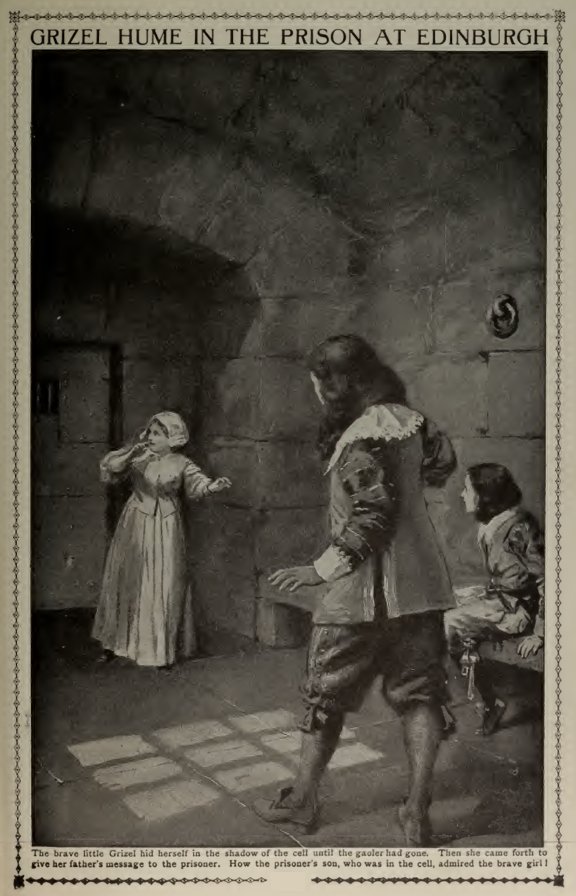
So brave little Grizel, this child of twelve, went in her father’s place.
Seeing a gaoler going into the prison, she popped in behind him and hid herself in the shadow of the cell until he had gone, then came forth into the middle of the cell and delivered the message which her father had given her. In the cell with the poor prisoner there was a little boy — George Baillie, the prisoner’s son.
How he admired the bravery and skill of the little girl in eluding the gaoler and getting into the prison!
She, on her part, admired the little boy, who was there sharing the misery of the cell with his father. Grizel managed somehow to get safely out of the prison and to make her way back from Edinburgh to her father’s home, taking the message which the prisoner had given her. Having executed Baillie, the authorities now thirsted for the life of the valiant Sir Patrick ; and about a year after the death of Baillie, the Humes heard that the soldiers were on their way to Redbraes Castle.
To be captured would mean death, but how was he to escape capture?
It was certain that he could not hide in or near the castle, for the soldiers would search every nook and cranny.
Sir Patrick, his wife, and Grizel, and a carpenter named Winter put their heads together, formed a plan and decided on a hiding-place.
They dared not let the other children or servants know it, for fear the soldiers should get the secret out of them. Winter and Grizel went at dead of night to Polwarth Church, which was a mile and a half from the castle.
There they carried a bed and bedclothes, and made a hiding-place for Sir Patrick in the family grave of the Humes in the church. In that resting-place of the dead, the living man was to take up his abode. He went as soon as the retreat was prepared, and when the soldiers arrived at the castle not a trace of him could they find.
They could only believe that he had fled from the neighbourhood.
Meanwhile Grizel’s father was safe in the church vaults, but he had to be fed. He could not return to the castle, for the soldiers lingered in the neighbourhood; but where he was he might as well be dead, so helpless was he.
Brave Grizel was equal to this difficulty also. Night after night she carried food to her fugitive father. The task of getting this food was in itself very hazardous. It would not have done to take it from the larder, for the servants would have missed it, and have had their suspicions aroused. The only way was for poor Grizel to smuggle the food off her plate, and into her lap, as she sat at meals. That was her method, and once she was nearly discovered. Her mother gave her a very bountiful plateful, and presently one of her brothers, looking at her plate, noticed that practically the whole supply had disappeared, and called the attention of the others to what he thought was Grizel’s greediness in eating so much with such speed.
But the smuggling of the food to her father was not Grizel’s chief difficulty. Every night, at twelve o’clock, she used to set off to walk the lonely mile and a half to the church. Of course, she had to go alone. That in itself was a terrible trial for the nerves of a young girl. The thought of passing through a graveyard at that hour of night would have sufficed to scare most people.
But, in addition, Grizel ran the danger of discovery by the soldiers who were in the neighbourhood, and of meeting country people out poaching, who would have followed and spied upon her. Then there were dogs at large to bark at her and increase her terrors.
But she smothered all her fears, and, night by night, went bravely on her way to feed her father, to stay and talk for some time with him, to cheer him with such news as she could tell him, and to inspire him with courage to bear his dreadful captivity. At last Grizel thought it would be safe for her father to return to a hiding place in the castle.
So she and Winter dug a great hole in the basement of the castle. They were afraid to use a spade lest the noise should be heard; so they used their finger-nails for the work. Early every morning they would take up, in a cloth, the soil which they had dug out during the night, and empty it away in the garden, and then cover over the hole so that nobody should find it. At last the hole was made of sufficient size to admit a sort of big box.
In this they placed bed and bedding, and then, one night, Sir Patrick crept home and hid himself in the new sanctuary. For a week this refuge held good, but water drained into the hole and made it impossible for Sir Patrick to remain, so he now determined to flee abroad for safety.
Grizel altered his clothes to make them like the clothes of a peasant, and, when news came to the house that the soldiers were again on the hunt for him, he set out.
After many dangers he made his way to London, and, giving his name as Dr. Wallace, got a passage on board a ship which took him to the Continent. His estates were now declared forfeit to the Crown, and the family were left without means.
Grizel and her mother went boldly to London and pleaded for support, and eventually they were granted $750 a year out of the estate. Sir Patrick was not idle in the meantime. He joined with others in an invasion of Scotland, but this was defeated, and he had to retire to Ireland, accompanied by his wife and all the children but one, a daughter who was left in Scotland.
But the others could not rest without her, so off to Scotland went Grizel, alone into all the dangers of that unhappy country. She rescued her sister, collected some money owing to her father, and then set out to Holland, where the others had gone in advance. After a journey of many perils she joined them, and for nearly four years the family lived in Holland.
Grizel was the little mother of the family. She relieved her mother of the cares of the household, and, when she had any time to spare, she studied music and languages and wrote quite charming poetry. The family were very poor, of course, but with such a girl to inspire them, how could they help being happy?
Grizel used to say that those years of poverty were the happiest of her life.
She had by this time grown into a beautiful and accomplished young woman, and more than one handsome young man sought her hand.
But little George Baillie had, by this time, developed into a handsome, brave young fellow, and, an exile from home, was serving in Holland in the Guards of the Prince of Orange.
The friendship begun in childhood between himself and Grizel had ripened, and, poor as they were, the two loved and hoped. At last their reward came.
The Prince of Orange entered England with an army, and the wretched King James II., who had succeeded to the throne at the death of his brother, Charles II, was driven from the land. Then those good and brave men who had suffered in the evil days were restored to their estates. The Princess of Orange so admired Grizel that she wished to make her a Maid of Honour, and always have her at Court.
But Grizel preferred to return to Scotland with her father, who was now created Earl of Marchmont, and made Lord Chancellor of Scotland. Grizel, as an earl’s daughter, now became Lady Grizel Hume. But she was not long to be known by that name. George Baillie had returned to Scotland, and the sweethearts were at last able to be married, fifteen years after they had first met, as boy and girl, in a prison cell.
– Child’s Book of Deeds.
– Home –
Character. Character Assassination. Children. Computing. Crosswords. Driving. Education. Electronics. Garden/Yard. Good Man Images. Fitness/Health. French. Homeschooling. House Ideas. How To. Interesting & Helpful Videos. iPad. Jokes. Kitchen/Cooking. Love, Courting and Marriage. Mechanics/Machines. Motivation/Advice. Movies. Music. Narcissism, Abusers & Covert Manipulators. NZ. OOS/RSI. Parenting Idea’s, Tips, Thoughts etc. People. Personal Care. Parenting & Children – Notes. Photography. Plumbing. Poetry. Politics. Product Reviews. Projects. Proverbs. Religion. Reviews.
Sewing. Skills/Hobbies. Slang. Stories & Books. Tips.
Tools. Toxic Parenting. Whats It Mean? Welding. Women. Words. Woodwork. Woodwork Basic Lessons.
===
From Boys to Men.
===
===
© 2021-2026 – James Martin Sandbrook. All Rights Reserved.