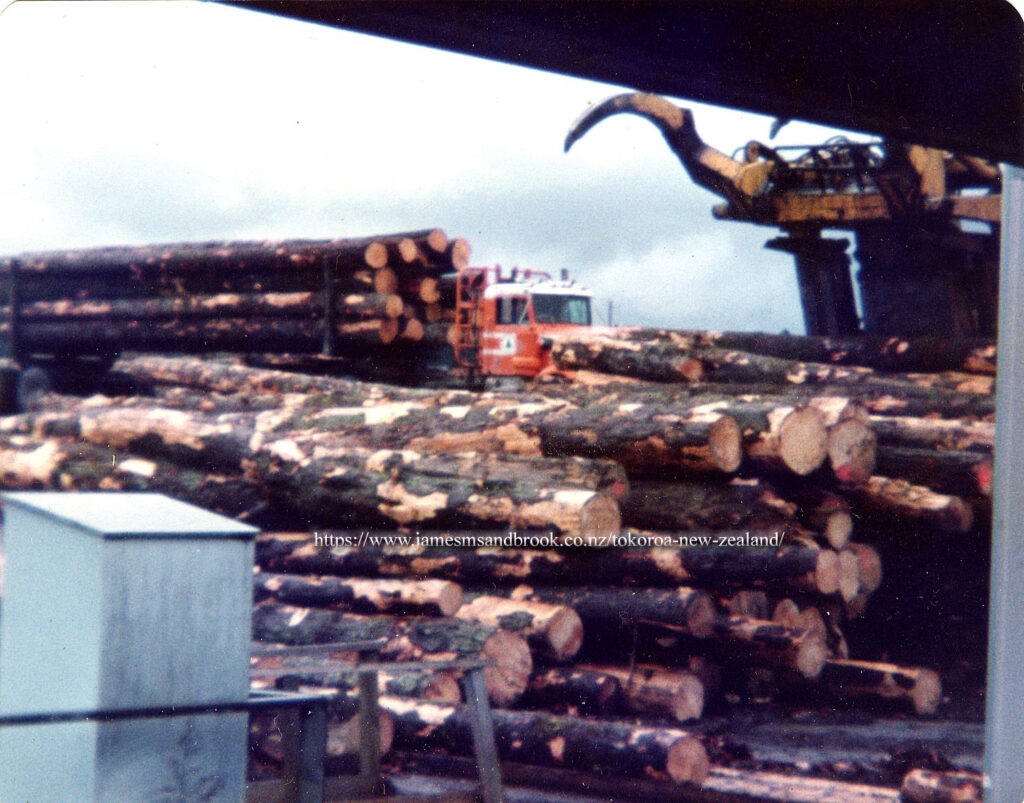
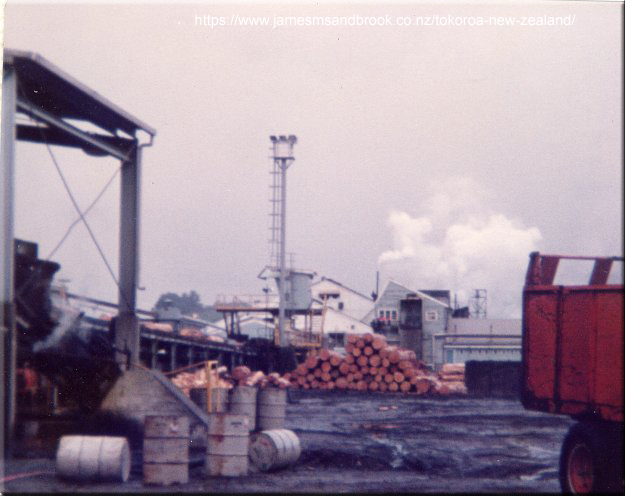
Here we see a logging truck with logs, and the machine that I called The Claw dropping off an entire truck load of logs so that the RB Crane Operator could put the logs on the chains.
The Claw operator/driver would call up up on the radio-transmitter to let us know that he was dropping some logs off, and we had to grab a log in the RB crane ‘tongs” and use that log to stop the avalanche of longs coming down, to stop the logs falling over the edge and causing a mess, making it harder to get the logs on the chains.
A video of “A Claw” removing logs from a logging tuck and putting them onto come conveyor.
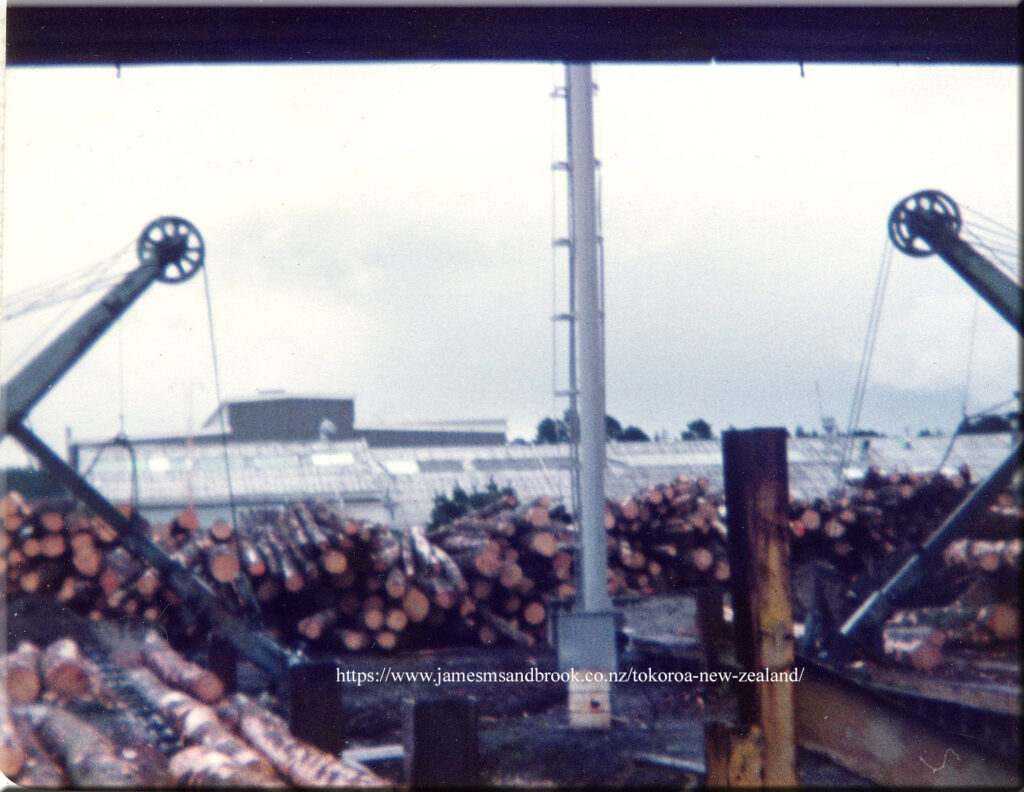
Here we see 2 of the Ruston-Bucyrus (RB) cranes. This photo was taken from the Sawyers hut at the beginning of the logs journey to the Sawmill or Number 6 Chipper. These cranes were big, heavy, and noisy, also they smelled of diesel and oil. They were painted that Kinlieth-Orange colour back then.
I learned how to operate the cranes but was not allowed to do so because the Supervisor and I didn’t get on well (he didn’t get on with most people).
I remember once getting angry because they would not replace a steel step to the tower that was dangerous, so I stomped on it hard and it broke as it was only just hanging on (thus someone could have stood on it and fallen a story down), and the supervisor threatened me with my damaging work property 🙂 So I asked him if I were Superman 🙂 And he let it go.
Anyway, the night shift Foreman would let me operate the cranes, and he told me that I was better than most of the experienced workers. I was 18 when I started at that job, but not sure how old I was when using the cranes, late teens if I remember correctly. After the supervisor found out that I was driving the cranes he got very upset and demanded that no one let me use them again, and refused to let me get my crane license that Kinlieth paid for back then, but he let others get it.
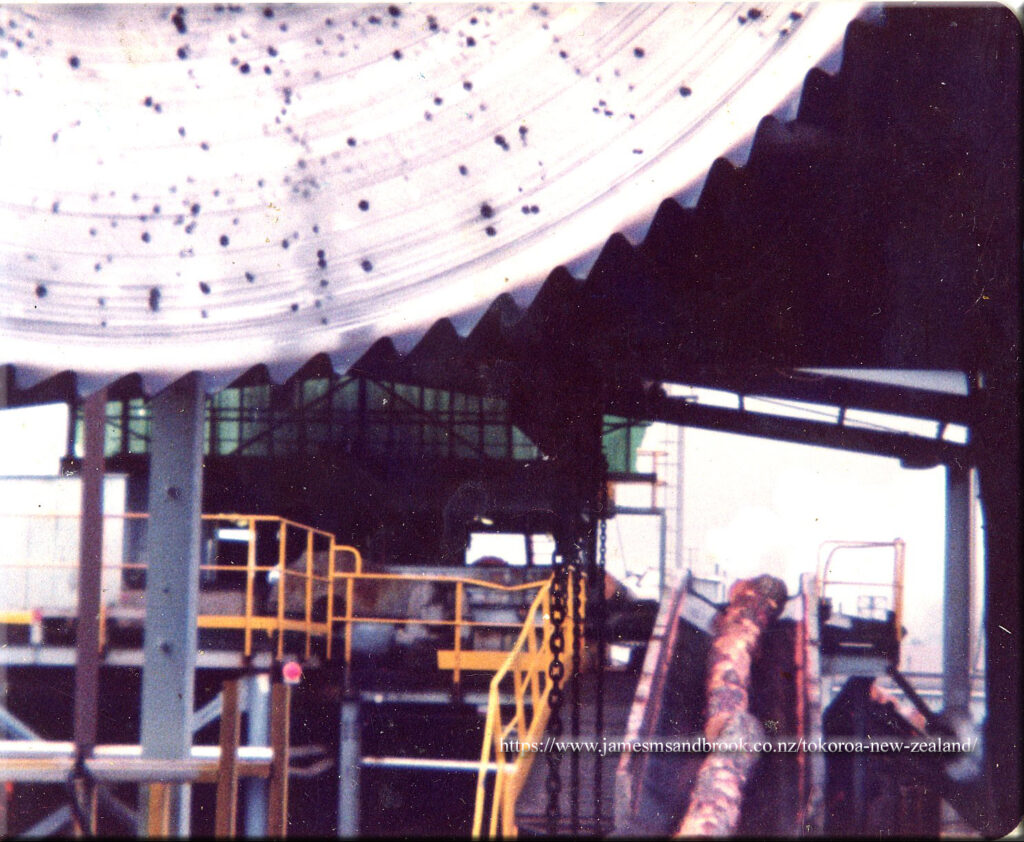
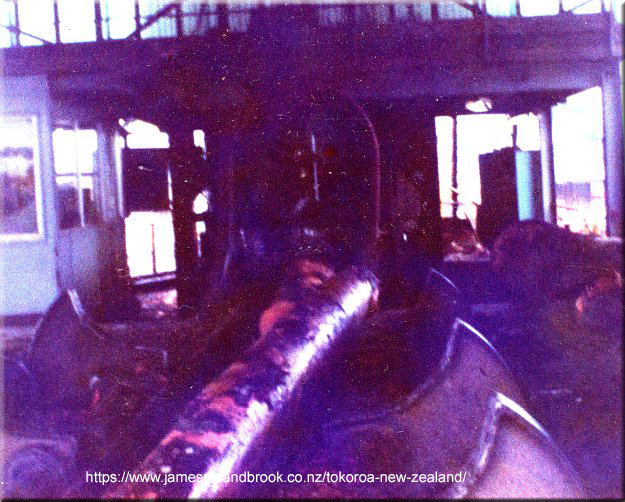
The logs were brought to the logend by logging trucks, offloaded and then someone operating the RB Cranes would take a log, one by one, and put them on the chain so that the log could enter the Sawyers area to be cut into useful lengths then they would head up into the De-Barker which is seen in the photo below at the top of the stairs. The De-Barker stripped off the bark on the logs.
The saws were large, very heavy, and very sharp. Changing the saws was a dangerous job that we did often, once a day if I remember correctly.
Here we have a log on the De-Barker deck ready to get the bark taken off it. On the Left we can see the hut that the De-Barker operator operated the controls in.
Here is a view of the tower, log conveyor, and in the distance is Number 6 Chipper (barely seen here) and the big building with steam coming out of it was the Sawmill itself.
We can also see under and to the back of the tower a stack of logs waiting to be put on the conveyor with an RB crane. If there were any mechanical issues or breakdowns the RB crane operator would put logs on the conveyor so that the Sawmill got a constant feed of logs.
So, when the going was good they stacked logs there, and when something went wrong they put logs on the conveyor to feed the Sawmill to keep production running.
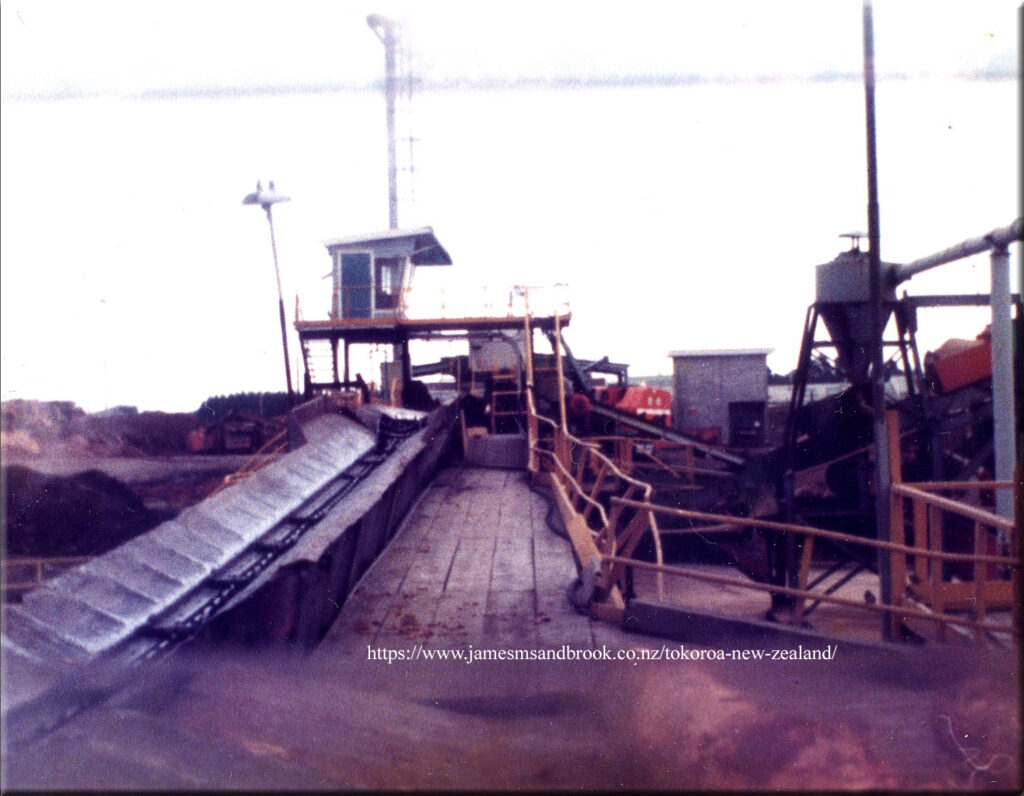
What we see here is what was called The Tower. A man sat inside and watched the chains below which carried the logs to the Sawmill and the Reject Area that if the log was reject it was kicked off the chain/skids and on to the Number 6 Chipper Deck. This photo was taken from the hut that the man who operated the Reject Kicker worked, at the other end is the Sawyers hut.
The man in the tower had to watch the logs as they went from one chain to another, as sometimes they would overlap and the log would fall off. If the logs fell it was dangerous for anyone below.
If you look carefully there is a log on the deck ready to be chipped up.
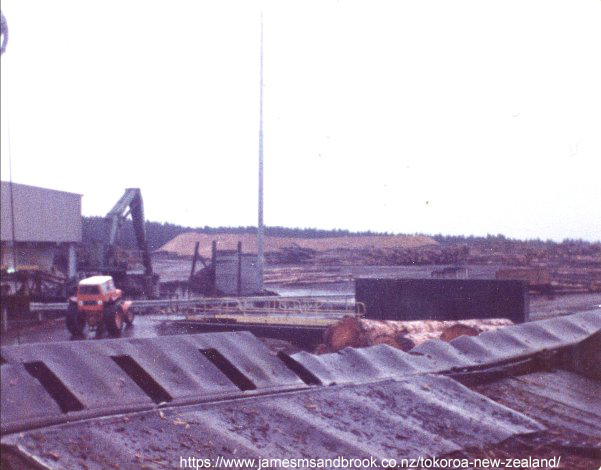
In the background in this photo we see the Plywood mill where they fed in the logs to be peeled and made in to Plywood. Going past is one of the Ford Tractors we drove to pull the big heavy trailers, and the 4 steel slots we see are the log kicker prongs came out and pushed the log off the steel conveyor on to the Number 6 Chipper deck.
The “Kicker” as we called it was driven by steam and was very powerful.
This is Torrence Ogle walking towards the Reject Operators Hut, just in front of Torrence is where the logs that went into Number 6 Chipper were.
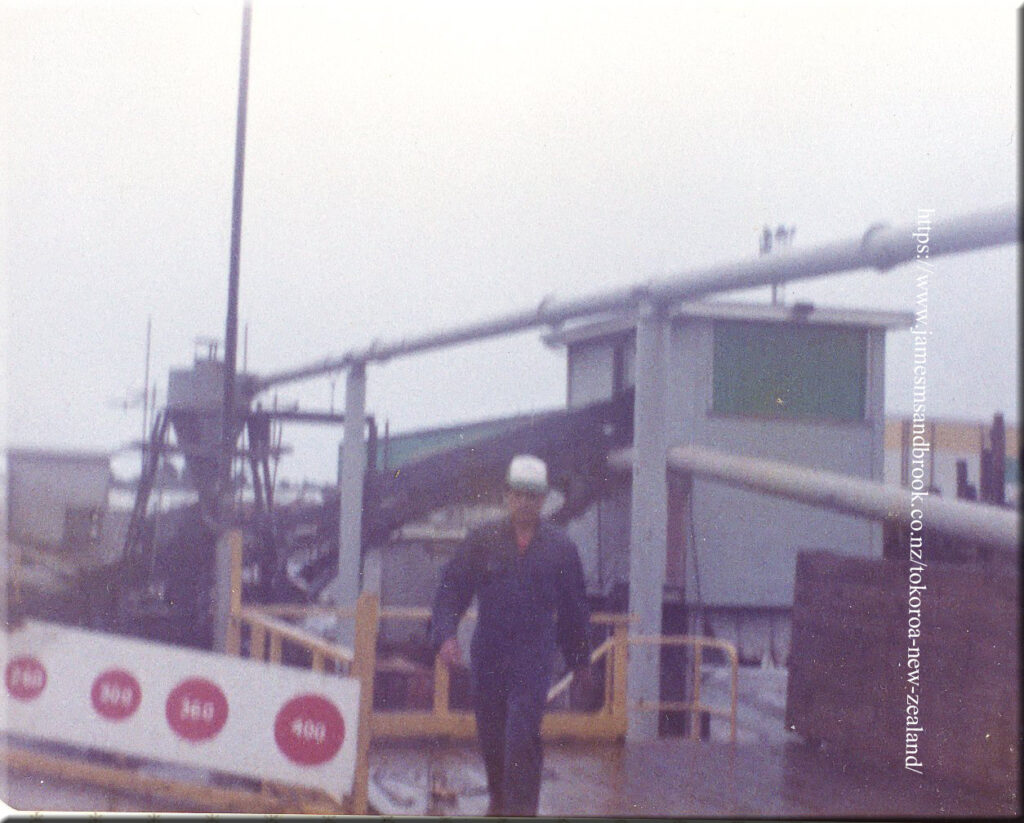
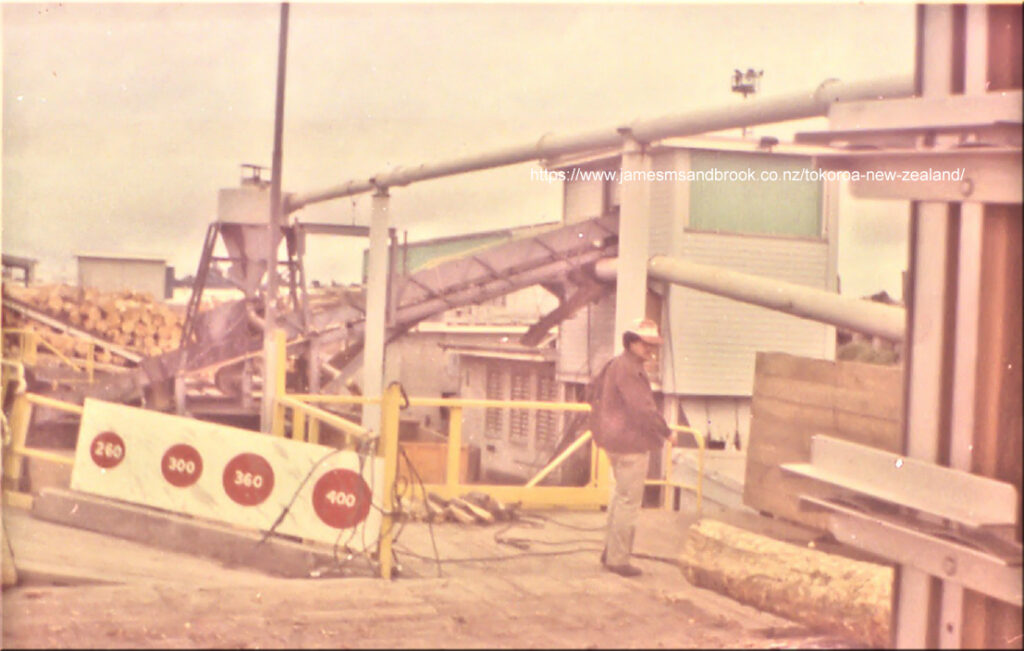
This is a clearer photo, in the late 1980s, of Torrence Ogle leaving the chipper deck. next to him is a log about to go into Number 6 Chipper. The sign with the sizes on it were to show the Reject Button Operator the diameters of the logs. At the back we see the Hopper, and the long conveyor belt of rubber that took the bark into the Hopper to be crushed.
This conveyor belt had a mental box over it that had a magnet in it to catch any metal on the conveyor belt.
The photo was taken from inside the Reject Button hut and this can be seen by the louver window slots on the right that hold the glass or which we removed so that we could see clearly in foggy conditions.
On one shift I was looking away to talk to some one about the job and I heard the RB crane horn beep, and a log had twisted, come off the metal log conveyor and was entering this window, so I had to immediately turn off the conveyor otherwise get a sore head.
A photo of Number 6 chipper where the blades are turning and some wood by the blades.
This video below is not Number 6 Chipper, but it shows a log chipper in action.
Number 6 chipper was a big disc with large extremely sharp blades. We would have to change the blades on day-shift and the Union demanded that we wear safety gloves, but the blades were so big and heavy that they easily would have sliced through a hand or removed it due to how sharp they were.
Remember, these chippers had to chop large heavy logs into little squares of about a few centimeters. Changing the blades each day was dangerous, but as long as we were careful we had no accidents while I was there.
The design of the log chippers was clever, the blades and the angle that they are on is designed so that when a log starts to get chipped the blade would pull the log in further so that even if the conveyor was turned off the log would continue to be pulled into the chipper.
The most dangerous issue we had was if a chuck on log got caught at the end of the chain where it went down and started its path back. The conveyor would jam, stop, and we had to get a long thick steal crowbar about 6 feet tall, about 1.8 meters, and then hop in to the area about a couple of feet, half a meter, from the chipper blades that were whirring at great speed and try to dislodge the stuck chunk of log. This was extremely dangerous, but if the chipper were turned off it would take about half an hour or so to stop.
No one as far as I ever heard ever got hurt doing this. The real scary part was feeling the wind from the blades against your legs as you tried to dislodge what was jamming the conveyor. I have no idea if people still do this that way these days.
A man went through a chipper at Kinlieth and died, but I don’t recall how it happened, and it was at another chipper, as there were a few of them on site.
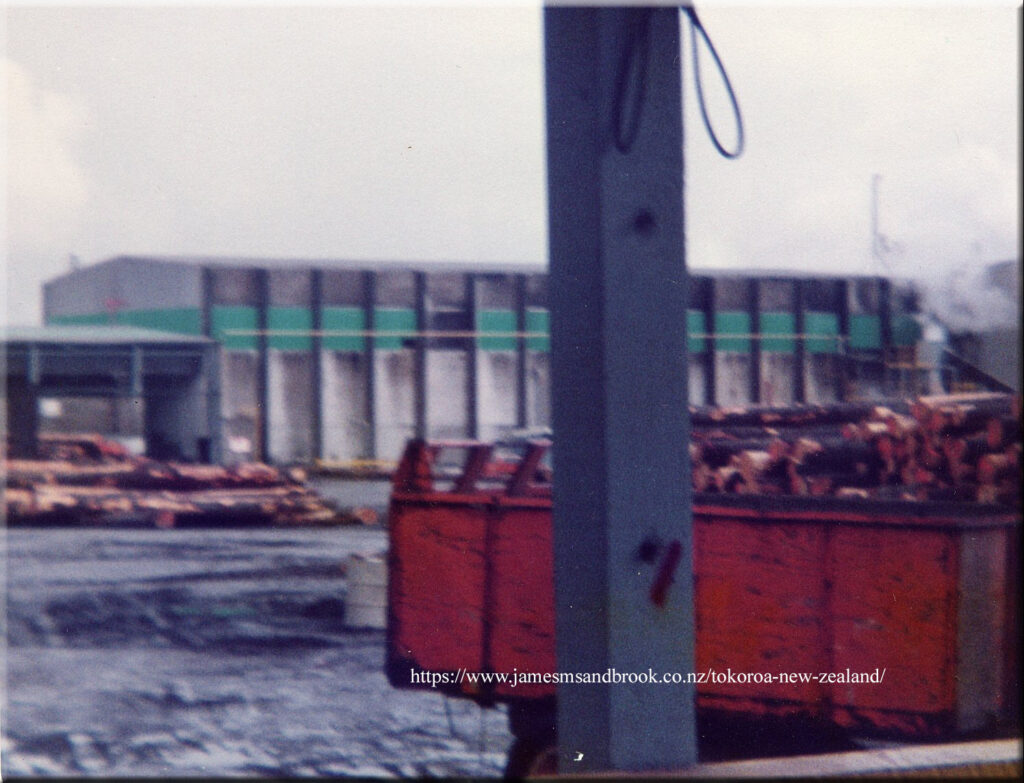
Here we have a look at the Plywood mill from the Sawyers hut area. The trailor we see here is the one that caught the “log-ends” that were cut off the logs when the ends of the logs were cracked, not straight etc. The log-ends were taken out to the Kinlieth carpark and left there for the public at a wood dump area to be used in people’s fireplaces.
What we used to haul these large trailers were Ford Tractors that were fast and had the hydraulics etc for the job. It was always exciting coming down a hill with speed and the trailer would come un-hitched thus it would push the tractor down the hill 🙂
The tractors had a brake pedal for each side, so if you went towards the tractor to hitch it up, and hit the pedal for one side in the mud the tractor would spin and you just then backed it up 🙂 I have to say that this type of behaviour was probably frowned upon by the head office.
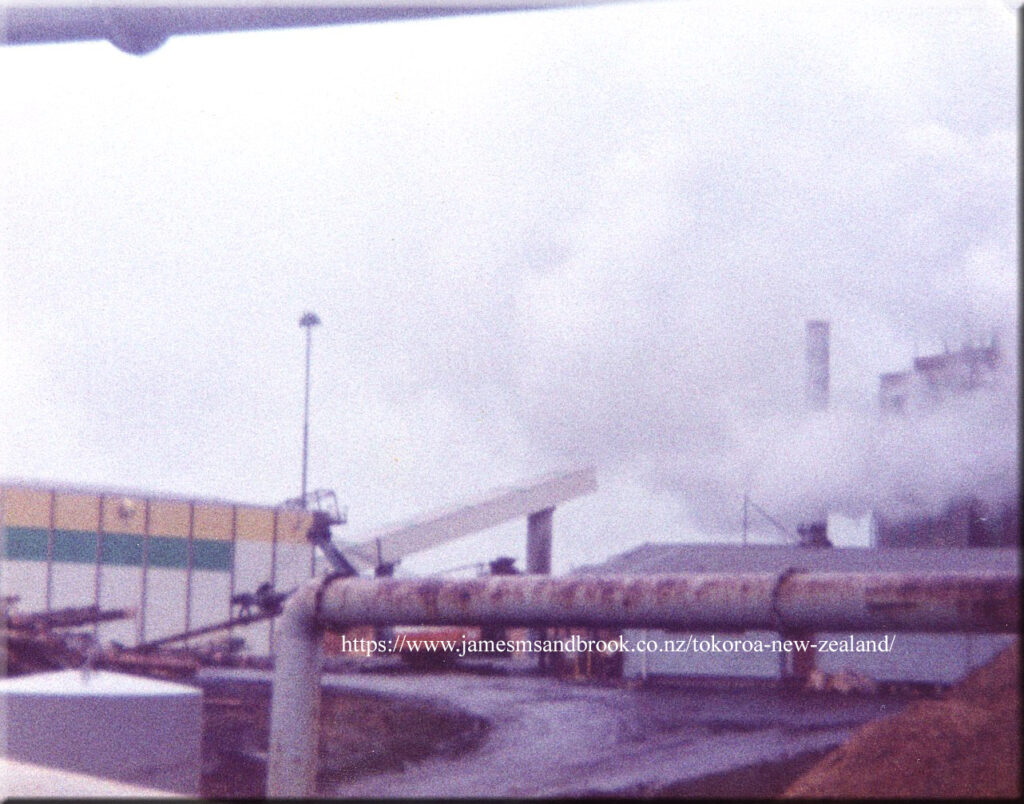
This was taken from the top of Number 6 Chipper deck. The photo shows the area towards the Digester and so on.
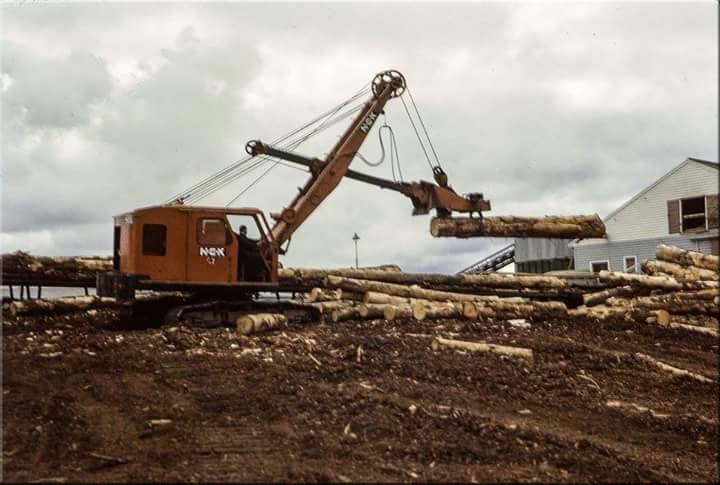
This crane photo is not off our Sawmill Logend, but it shows a log in the crane tongs being picked up and moved.
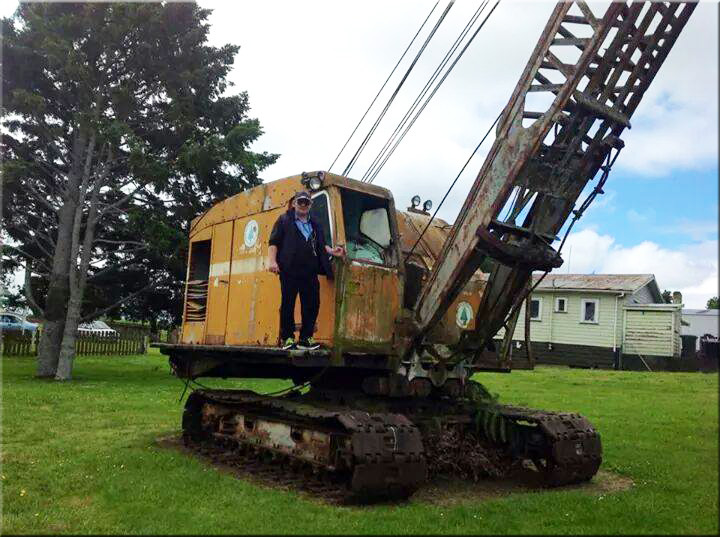
Me on the RB Crane at the Putaruru Museum back in 2017